

In many discussions about AI literacy, a natural follow-up question quickly appears: What does Knowledge Management literacy mean inside organisations?
Τhe term is often mentioned, but rarely explained in practical terms.
Knowledge Management literacy is not primarily about tools or platforms.
It is about understanding how organisational knowledge is recognised, structured, and validated so that it can reliably support decisions.The simple framework below summarises four practical capabilities that shape how organisations work with knowledge.

These capabilities may appear straightforward. In practice, they often determine whether knowledge supports sound decisions or simply turns into fragmented information.
1. Locate Knowledge
The first capability is the ability to locate where organisational knowledge actually lives.

In many organisations, knowledge is distributed across multiple systems: document repositories, collaboration platforms, shared drives, internal portals, and email archives. Without a clear understanding of this landscape, people often spend a considerable amount of time simply searching for information.
Knowledge Management literacy therefore begins with a basic awareness of the organisation’s knowledge environment: where different types of knowledge are stored and which systems serve which purpose.
Without this basic capability, organisations struggle to use knowledge consistently, whether by people or by AI systems.
2. Identify the Authoritative Source
Locating information is not enough. The next step is recognising which version of knowledge can be trusted.

In practice, organisations often operate with multiple versions of the same document, guideline, or procedure. Teams may rely on different sources without knowing which version is officially maintained.
Knowledge Management literacy therefore includes the ability to identify the authoritative source: the version of knowledge that is validated, maintained, and intended to guide decisions.
3. Understand Knowledge Context
Knowledge is never created isolation. It always emergies in a particular context: a regulatory environment, a project phase, and a specific organization challenge.
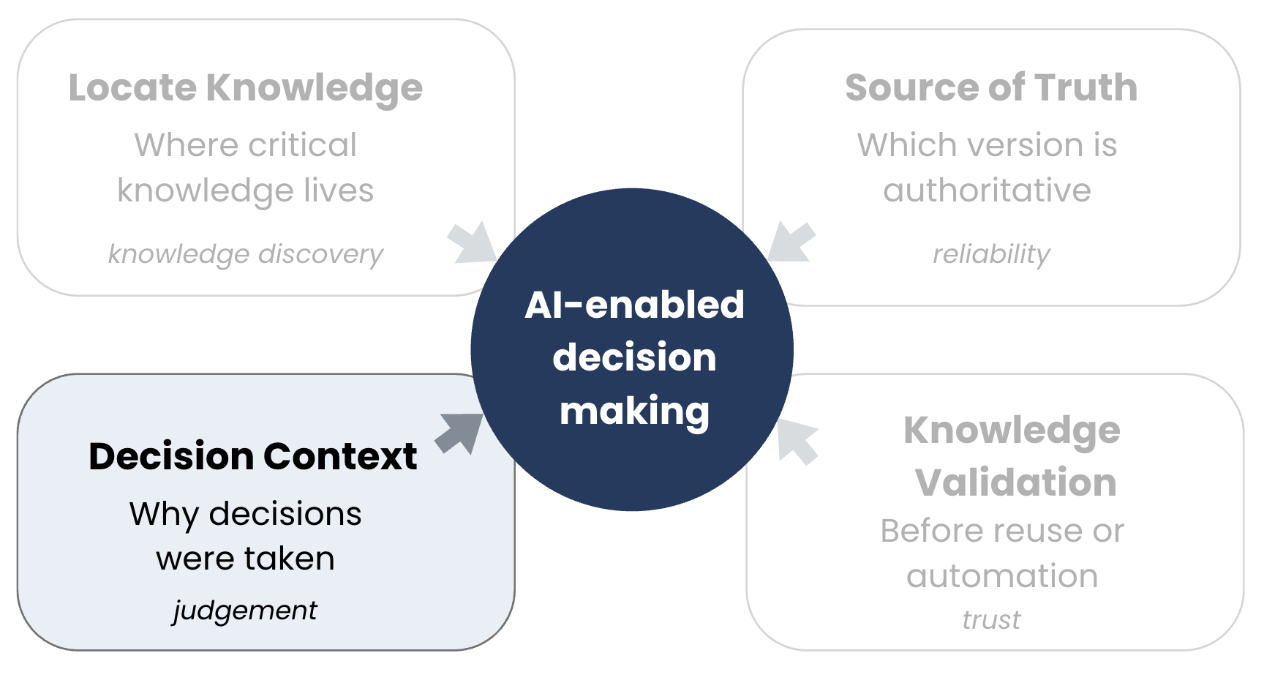
Understanding this context is essential for interpreting knowledge correctly. Without it, documents and guidance may easily be reused in situations where they no longer apply. Knowledge Management literacy therefore involves recognising how and why knowledge was produced, and under which conditions it should be interpreted.
4. Validate Knowledge before reuse
Finally, knowledge must be validated before it is reused, shared, or embedded in automated processes.

Organisations evolve, policies change, and procedures are updated. If knowledge is reused without verification, outdated information can easily spread across teams or systems.
Knowledge Management literacy therefore requires the ability to confirm that knowledge remains current and relevant before it is applied again.
Why these capabilities matter for AI
These four capabilities become particularly important as organisations explore AI-enabled systems.
AI can retrieve, process, and connect information at scale. However, the quality of its outputs depends directly on the structure and reliability of the knowledge it accesses, including the systems developed by generative AI development companies.
If knowledge sources are fragmented, unclear, or outdated, AI may simply accelerate confusion rather than support judgement.
For this reason, developing Knowledge Management literacy is not only a Knowledge Management concern. It is increasingly becoming a foundational capability for organisations seeking to use AI responsibly and effectively.

Future Knowledge Nuggets will explore these capabilities in greater detail and examine how organisations can strengthen them in practice.
Disclaimer: The views expressed in this article are my own and do not represent the position of my employer or any institution I am associated with.
__________________



.png)
.png)
.png)
.png)