

You probably remember someone like him: Tom, the senior policy expert who spent two decades at the institution. Tom remembered which decisions had been revisited three times before reaching their final form. Tom carried in his head the assumptions behind frameworks that now looked obvious but had been genuinely contested when they were designed.
Tom is "The Organisational Memory" :)
When he retired, the organisation held a warm farewell.Three months later, his former team faced a decision that depended on understanding why a key position had been taken eight years earlier. They found the approval. The minutes. The final document.They could not find the reasoning.It had retired with him.
The gap existing frameworks do not close
In a previous article, I introduced Structured Decision Continuity through the story of Sophia: every senior expert whose absence only becomes visible when the system that replaced her produces an answer that looks correct and is not.
The diagnosis is this: organisations do not fail because they lack knowledge. They fail because the continuity between their knowledge and their decisions is not governed.
SDC names that gap. At the centre of SDC sits the Control Layer, a practical model that examines whether the path from knowledge to decision is strong enough to survive over time.
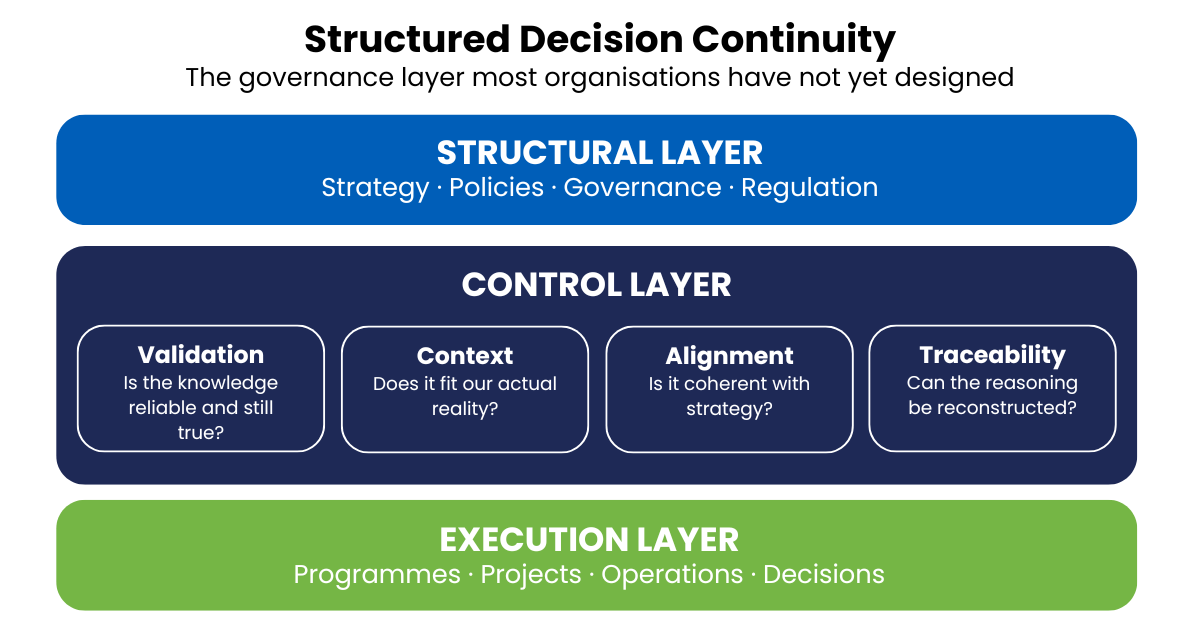
The Four Conditions
The Control Layer has four conditions. Each addresses a failure that senior professionals recognise but few organisations name explicitly
Validation
Was the knowledge behind this decision reliable and valid in context?
Validation ensures that information, analysis and expertise were sufficiently checked; not just accurate in isolation, but appropriate for the specific decision being made.
The failure mode is familiar: a recommendation sound in theory but built on data that no longer reflected organisational reality. Before closing any significant decision, one question is worth asking: what are we taking for granted that we have not actually tested.
Context
Will someone encountering this decision in three years understand the conditions that shaped it.
Context is the set of circumstances and constraints that existed at the moment a decision was made. It is why the decision made sense then; even if it looks different now.
Context is the component most commonly lost. It lives informally in the people who were present. When those people retire or move on, the context goes with them unless it has been deliberately preserved.
Alignment
Was this decision coherent with strategy and governance and is that coherence still visible?
The failure mode here is subtle. A decision can be fully aligned at the moment it is made and look disconnected two years later, not because it was wrong, but because the strategy moved and no one recorded what the decision was originally aligned to.
Traceability
Can someone follow the path from knowledge to decision and from decision to consequence?
This is the expert's failure. The decision was defended procedurally. But the reasoning left with the person who held it. Traceability ensures that reasoning does not have to leave when the expert does.
Four Questions Worth Asking
For any decision that will carry long-term consequences, four questions are enough:
- Was the knowledge behind this decision sufficiently checked?
- Is the context preserved?
- Is the alignment with governance and strategy visible?
- Can the path from knowledge to decision be followed later?
If the honest answer to any of these is uncertain, something is worth capturing before the people who hold the answer have moved on.
A Closing Thought
The expert who retired took something with him that no record system was designed to preserve. Not his knowledge; much of that existed in documents. What left with him was the reasoning that connected that knowledge to the decisions that had shaped the institution.
The SDC Control Layer does not prevent people from leaving. It ensures that when they do, the reasoning behind their most important decisions does not leave with them.
Structured Decision Continuity is a developing professional concept examining how organisations preserve the reasoning behind important decisions over time. This is the fourth article in a series contributed exclusively to the Knowledge Management Institute.
The views expressed in this article are my own and do not represent the position of my employer or any institution I am associated with.
_______________________



.png)
.png)
.png)
.png)